RIVER GROVE, ILLINOIS · 2025 WATER DATA
Is River Grove's water good enough for your family?
River Grove's water meets federal standards. But a legal limit is not a health goal. Every figure on this page comes from Village of River Grove's published reporting — and every one is system-wide, not from your tap.

THE SUPPLIER
Village of River Grove
Lake Michigan surface water purchased directly from the City of Chicago, stored in the Village's underground reservoir, and pumped into the distribution system.
Source: Village of River Grove 2026 Annual Consumer Confidence Report (2025 data)
- River Grove's 2026 inventory lists 1,627 lead and 218 galvanized-requiring-replacement service lines out of 2,740.
- In 2025 tap sampling, individual lead results ranged up to 56.4 ppb at the highest site; the system-wide 90th percentile was 6.38 ppb, below the 15 ppb action level.
Two things to know
These are town-wide results. What comes out of your tap also depends on your own pipes and faucets. A town report can't see inside your house.
Legal limit isn't the same as the health goal. The legal limit is the most the law allows. The health goal is the level with no known risk. For lead, the health goal is 0.
RIVER GROVE WATER REPORT CARD
What River Grove's own water reports show.
Here's what River Grove's own water reports say, in plain English. Green means it looks good. Yellow means keep an eye on it. Red means it needs attention.
ppb = parts per billion. 1 ppb is about 1 drop of water in a backyard swimming pool.
The short version
- Some tested homes were over the lead action level
- A TTHM test went over the legal limit
- About 6 in 10 street water pipes are lead
- Most homes were built before lead solder was banned (1986)
- Chlorine by-products (HAA5) found, under the legal limit
- Chlorine is added to kill germs (can affect taste)
Lead in tested homes
Lead · 90th percentile
Needs attention
The town tests tap water in homes most likely to have lead. 9 out of 10 of those homes had this much or less.
6.38 ppb
parts per billion
Action level: if more than 1 in 10 tested homes go over this, the town must take extra steps.
Highest single test: 56.4 ppb
2 tested homes had more lead than the 15 ppb action level. A drinking-water filter certified for lead can help.
Source: Village of River Grove 2026 Annual Consumer Confidence Report (2025 data)
Chlorine by-products
Total trihalomethanes (TTHM)
Needs attention
Leftovers that form when chlorine cleans the water. The law limits them because drinking too much over many years may raise health risks.
59 ppb
parts per billion
Legal limit: the most the law allows.
Highest single test: 98 ppb
At least one test reached 98 ppb, over the 80 ppb legal limit.
Source: Village of River Grove 2026 Annual Consumer Confidence Report (2025 data)
Lead water pipes from the street
Service-line inventory
Needs attention
A service line is the underground pipe that brings water from the street into a building. Some old ones are made of lead.
1,627 of 2,740 street water pipes are lead
About 6 in 10
- Lead pipe: 1,627
- Old steel pipe that needs replacing (galvanized): 218
- Not known yet: 13
- Not lead: 882
About 6 in 10 water pipes from the street are lead. Check your address — if your home has one, a drinking-water filter certified for lead can help until it's replaced.
From the town's list, as of April 15, 2026.
Source: Village of River Grove 2026 service line material inventory (Illinois EPA)
Older homes
Homes built before 1980
Keep an eye on it
Lead solder and lead pipes were allowed in homes until 1986.
84.1%of River Grove homes were built before 1980 — about 8 in 10Homes built before 1986 can have lead solder or lead pipes inside, even when the street pipe is fine.
Source: U.S. Census Bureau, ACS 2024 5-year estimates (B25034)
Tested homes over the lead limit
Lead sampling
Needs attention
2tested homes had more lead than the 15 ppb action level2 tested homes had more lead than the 15 ppb action level. A drinking-water filter certified for lead can help.
More chlorine by-products
Haloacetic acids (HAA5)
Keep an eye on it
Another group of chlorine leftovers, also limited by law.
17 ppb
parts per billion
Legal limit: the most the law allows.
Highest single test: 21 ppb
Under the 60 ppb legal limit, but it's there. Our filter claims cover TTHM, not HAA5 specifically.
Source: Village of River Grove 2026 Annual Consumer Confidence Report (2025 data)
Copper in tested homes
Copper · 90th percentile
Looks good
Copper can get into water from pipes inside homes.
0.0661 ppm
parts per million
Action level: if more than 1 in 10 tested homes go over this, the town must take extra steps.
Far below the 1.3 ppm action level.
No action needed
Source: Village of River Grove 2026 Annual Consumer Confidence Report (2025 data)
Chlorine
Disinfectant residual
Good to know
Chlorine is added on purpose to kill germs in the pipes. The legal limit is 4 ppm.
1 ppmparts per million
Added on purpose to kill germs. It's the most common reason water tastes or smells like a pool.
Source: Village of River Grove 2026 Annual Consumer Confidence Report (2025 data)
Typical home age
Median year built
Keep an eye on it
Half of River Grove's homes were built before this year.
1963Homes built before 1986 can have lead solder or lead pipes inside, even when the street pipe is fine.
Source: U.S. Census Bureau, ACS 2024 5-year estimates (B25035)
PFAS ("forever chemicals")
Per- and polyfluoroalkyl substances
Looks good
Man-made chemicals that break down very slowly.
The City of Chicago, which treats the Lake Michigan water supplied to this system, reports non-detect results for PFAS in its 2014, 2020, and 2024 studies.
No PFAS found in testing.
No action needed
Source: City of Chicago PFAS findings
Where the water comes from
Lake Michigan surface water purchased directly from the City of Chicago, stored in the Village's underground reservoir, and pumped into the distribution system.
Source: Village of River Grove 2026 Annual Consumer Confidence Report (2025 data)
WATER WORDS, EXPLAINED
What these River Grove water report words mean
- ppb (parts per billion)
- 1 ppb is about 1 drop of water in a backyard swimming pool.
- ppm (parts per million)
- 1,000 times more than a ppb — about 1 drop in 13 gallons.
- Legal limit (MCL)
- The most of something the law allows in public drinking water.
- Action level
- A trigger for lead and copper. If more than 1 in 10 tested homes are over it, the water system must take extra steps.
- Health goal (MCLG)
- The level with no known health risk. For lead, it's 0. Health goals are not legal limits.
- 90th percentile
- Line up all the test results from lowest to highest. The 90th percentile is the number that 9 out of 10 results are at or below.
- Service line
- The underground pipe that carries water from the main under the street into a building.
- Galvanized pipe that needs replacing
- An old steel pipe coated in zinc. If it was ever connected after a lead pipe, it can hold lead and must be replaced.
- TTHM (total trihalomethanes)
- Leftovers that form when chlorine mixes with natural material in water. The law limits them because drinking too much over many years may raise health risks.
- HAA5 (haloacetic acids)
- Another group of chlorine leftovers, also limited by law.
- PFAS
- A big family of man-made chemicals, sometimes called "forever chemicals" because they break down very slowly.
- Reverse osmosis (RO)
- A filter that pushes water through a very fine layer to remove many things. It sits under the kitchen sink and gives you one tap of filtered drinking water.
- Whole-home carbon filter
- A large filter where water enters the house. It removes chlorine taste and smell at every tap.
- Water softener
- Removes the minerals that make water "hard" — the white spots and scale. It does not remove lead.
- NSF/ANSI certification
- An independent lab test proving a filter really reduces what it claims. We list the exact certificate on your quote.
WHICH FILTER FIXES WHAT
Which filter fixes which problem?
Find your problem on the left. A green check means that system helps.
Yes, it helps Only certain models No, it doesn't
| Water problem | Under-sink ROFilters drinking water at the kitchen sinkfrom $1,195 | Whole-home carbonFilters all the water coming into your housefrom $1,795 | Water softenerStops hard-water spots and scalefrom $1,795 | Complete Home SystemAll three togetherfrom $2,699 |
|---|---|---|---|---|
| Lead | Yes — certified to reduce lead (NSF/ANSI 53/58) | No — doesn't remove lead | No — doesn't remove lead | Yes — at the kitchen sink (through the RO) |
| Chlorine by-products (TTHM) | Yes — certified to reduce TTHM (NSF/ANSI 53/58) | Only some models — ask for NSF/ANSI 53 | No | Yes — at the kitchen sink (through the RO) |
| Chlorine taste & smell | Yes — at the kitchen sink | Yes — at every tap (NSF/ANSI 42) | No | Yes — at every tap |
| Hard water & scale | No — not a softener | No — not a softener | Yes — sized to your water (NSF/ANSI 44) | Yes — whole house |
| PFAS ("forever chemicals") | Yes — certified to reduce PFOA/PFOS (NSF/ANSI 53/58) | No — not certified for PFAS | No | Yes — at the kitchen sink (through the RO) |
Lead
- Under-sink ROFilters drinking water at the kitchen sinkYes — certified to reduce lead (NSF/ANSI 53/58)
- Whole-home carbonFilters all the water coming into your houseNo — doesn't remove lead
- Water softenerStops hard-water spots and scaleNo — doesn't remove lead
- Complete Home SystemAll three togetherYes — at the kitchen sink (through the RO)
Chlorine by-products (TTHM)
- Under-sink ROFilters drinking water at the kitchen sinkYes — certified to reduce TTHM (NSF/ANSI 53/58)
- Whole-home carbonFilters all the water coming into your houseOnly some models — ask for NSF/ANSI 53
- Water softenerStops hard-water spots and scaleNo
- Complete Home SystemAll three togetherYes — at the kitchen sink (through the RO)
Chlorine taste & smell
- Under-sink ROFilters drinking water at the kitchen sinkYes — at the kitchen sink
- Whole-home carbonFilters all the water coming into your houseYes — at every tap (NSF/ANSI 42)
- Water softenerStops hard-water spots and scaleNo
- Complete Home SystemAll three togetherYes — at every tap
Hard water & scale
- Under-sink ROFilters drinking water at the kitchen sinkNo — not a softener
- Whole-home carbonFilters all the water coming into your houseNo — not a softener
- Water softenerStops hard-water spots and scaleYes — sized to your water (NSF/ANSI 44)
- Complete Home SystemAll three togetherYes — whole house
PFAS ("forever chemicals")
- Under-sink ROFilters drinking water at the kitchen sinkYes — certified to reduce PFOA/PFOS (NSF/ANSI 53/58)
- Whole-home carbonFilters all the water coming into your houseNo — not certified for PFAS
- Water softenerStops hard-water spots and scaleNo
- Complete Home SystemAll three togetherYes — at the kitchen sink (through the RO)
Filter claims apply to the exact certified model named on your quote, used and maintained the way the maker says.
COMPLIANCE
Reported compliance notes
For July 1–September 30, 2025, the Village reported a total trihalomethane (TTHM) monitoring violation: the original sample was not analyzed within the required period.
Source: Village of River Grove
What this page cannot tell you
These are town-wide results. What comes out of your tap also depends on your own pipes and faucets. The only way to know for sure is to test your own water — we'll tell you that even when it means you don't buy anything from us.
FREE PDF GUIDE
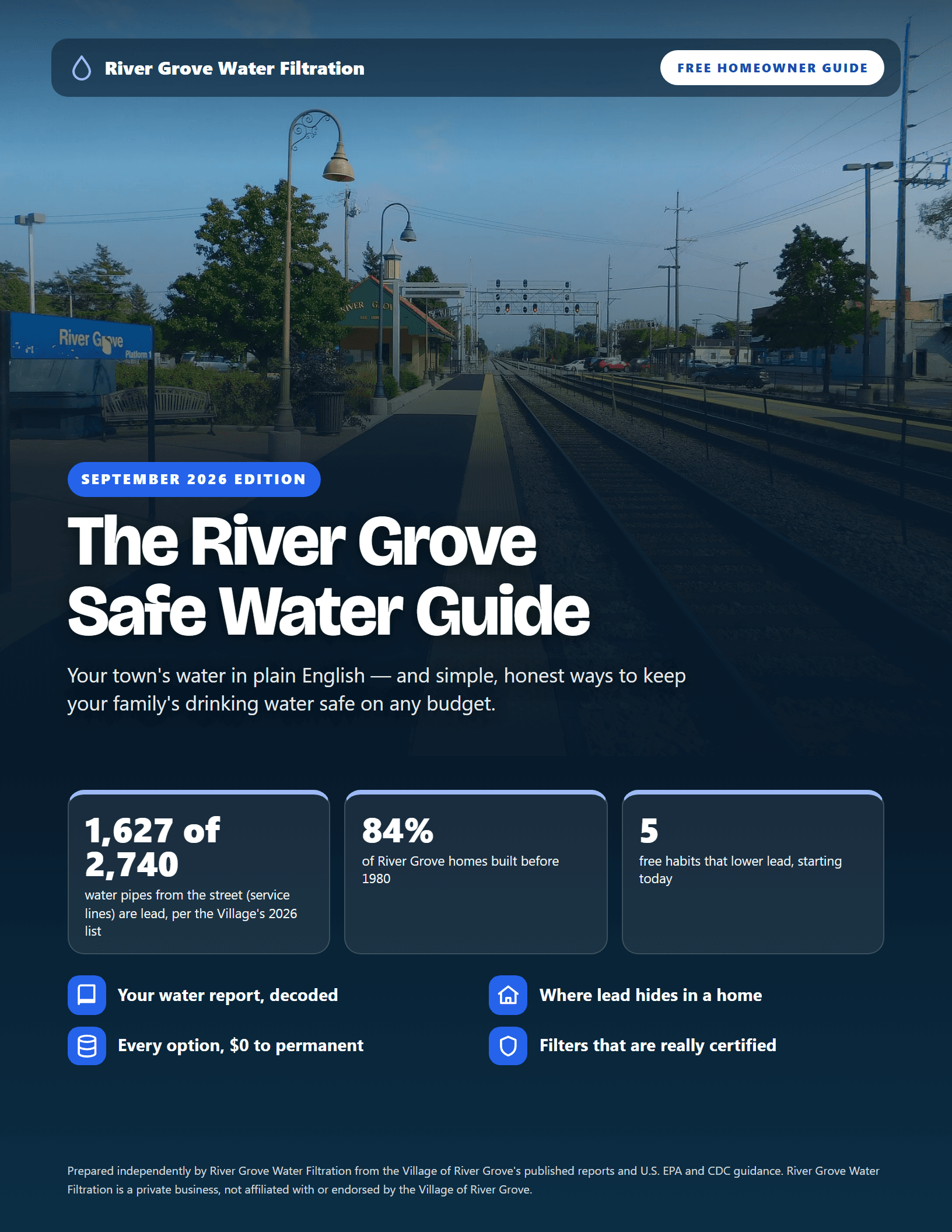
The River Grove Safe Water Guide
Your town's water numbers in plain English, free habits that lower lead, how to pick a certified pitcher filter, and when a permanent system makes sense. Sent to your inbox.
Get the free guide